Precision Die Casting Trimming

Rapidoparts delivers expert die casting trimming and die trimming services , removing flash, gates, runners, and overflow material with precision tooling to ensure every part meets your dimensional and aesthetic specifications.

±0.1 mm Tolerance

10K+ Parts Per Run

Al · Zn · Mg Metals Supported

100% QC Inspected

Trusted by the companies

ISO 9001:2015

ISO 13485:2016

AS9100D

ITAR Registered

NADCAP Accredited

What Is Die Casting Trimming?

Die casting trimming is the process of removing excess material , known as flash, runners, gates, and overflows , from a die-cast part after it has been ejected from the die casting machine. These by-products are an unavoidable result of injecting molten metal under high pressure into a steel mould.
Without proper die trimming, parts fail to meet dimensional tolerances, present poor surface aesthetics, and may interfere with downstream assembly or finishing operations such as painting, plating, or CNC machining.

01

Flash

Ultra-thin layers of metal that seep out between die halves during casting. Even paper-thin flash causes dimensional inaccuracies and must be cleanly removed.

02

Runners & Gates

The channels and openings through which molten metal flows into the cavity. These solidify with the part and must be sheared off cleanly without damaging the casting.

03

Overflows & Vents

Relief reservoirs that capture trapped air and metal during injection. Post-ejection, overflow tabs must be removed as part of the standard trimming operation.

04

Burrs

Residual material at ejector pin marks and parting lines. Deburring is often performed alongside trimming to deliver a fully finished, assembly-ready surface.

How Is Die Trimmed?

A die cast die is formed from two halves: the cover die (cover half), which is mounted to the fixed platen of the machine, and the ejector die (ejector half), which is mounted to the moving platen. Together, the two halves form a closed die cavity

During the casting process, molten metal is injected under high pressure through the cover die, filling the die cavity via the runner system and gates.

A trim die , a purpose-built trim tool mounted in a trim press, is engineered as a complete die matched to the exact profile of the casting. When the cast part is placed in the trim press and the hydraulic cylinders drive the tool through its stroke, the excess material is sheared cleanly away. The result is a dimensionally accurate, flash-free casting ready for post-processing. For designs with multiple cavities, a single trim die stroke can process all cast parts from one shot simultaneously
Our Die Trimming Process

01

Casting Design Review & Tooling

Our engineering team analyses your CAD data and casting design to engineer a complete die trim tool matched precisely to your part’s profile ,accounting for gate positions, parting line geometry, cores, slides, ejector half layout, and unit die requirements.

02

Trim Die Fabrication

Precision trim dies are manufactured to your part specifications. The trim die is validated against first-article cast parts before production begins, ensuring the tooling achieves the required dimensional accuracy from the first stroke.

03

Trim Press Operation

Cast parts are positioned ,manually or by robot ,in the trim press. Hydraulic cylinders drive the trim tool through a single controlled stroke, shearing flash, runners, and overflows cleanly from the casting without causing part distortion or damage to critical features.

04

QC Inspection

Each batch undergoes dimensional accuracy checks using calipers, micrometers, and CMM where required. Surface finish and parting line cleanliness are verified before conforming cast parts are packed and dispatched.

Die Casting Trimming Methods

Method 01 – Mechanical Shear Trimming

A high-volume method using a precision trim die in a hydraulic press to remove excess material in one stroke. Fast, repeatable, and cost-effective for aluminum, zinc, and magnesium castings.
High Volume

Method 02 – Manual & Hand Trimming

Used for delicate areas where automation may cause damage. Skilled technicians remove gates and flash by hand to protect complex features and sensitive surfaces.
Complex Geometry

Method 03 – Deburring & Edge Finishing

Removes burrs after trimming using cutting, grinding, or sanding. Ensures a smooth, consistent surface before coating or finishing processes.
Surface Ready

Method 04 – Tumble Deburring

Batch process using tumbling equipment and abrasive media to deburr large quantities efficiently, ideal for small, complex parts.
Batch Efficient

Method 05 – Laser & Thermal Trimming

Uses high-energy lasers for precise trimming of complex or thin-walled parts where mechanical methods may cause distortion.
High Precision

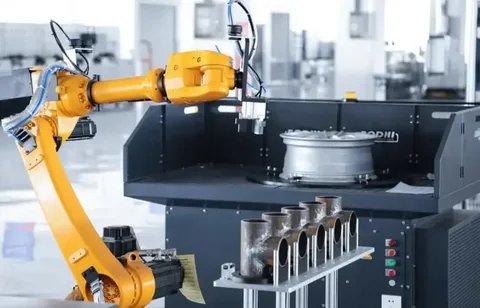
Method 06 – Robotic / Automated Trimming

Automated system where robots handle and position castings for trimming, improving speed, consistency, and reducing manual handling.
Automation

Benefits of Professional Die Trimming

Dimensional Accuracy

Precision trimming ensures die cast parts meet specified tolerances and fit correctly during assembly ,critical for automotive, electronics, and medical applications where every micron matters.

Superior Surface Finish

Clean trimming of flash and overflow material produces a professional surface finish across cast parts, ready for painting, anodising, powder coating, or plating without additional rework.

Extended Service Life

Removing excess material and burrs at ejector pins and the parting line eliminates stress concentration zones, ensuring cast parts achieve their full service life under operational load cycles.

Efficient Production Cycles

Automated trim die and trim press operations are far faster and more consistent than manual methods, reducing per-unit cycle time and lowering overall production cost for high volume die cast runs.

Scrap Recovery & Cost Reduction

Trimmed runners, gates, and flash are separated, collected, and returned to the melt as recyclable metal ,minimising scrap cost and improving the overall material efficiency of the casting process.

Industries We Supply

Rapidoparts delivers die casting trimming services across a broad spectrum of demanding industries.

Automotive

Engine covers, transmission housings, and structural brackets ,die cast trimming of high pressure die cast aluminum components at volume.

Electronics

Heat sinks, enclosures, and telecom housing cast parts where surface finish and dimensional accuracy are critical features.

Industrial Equipment

Pump bodies, valve housings, and gear cases where excess material and defects must be fully removed post-casting process.

Medical Devices

High-tolerance instrument housings where the trimming process must achieve exceptional quality without part distortion.

Aerospace

Lightweight aluminum and magnesium complex components where parting line flash and runner residue affect structural integrity.

Power Tools

Gear housing and motor casings ,die cast parts requiring clean trim tool separation of gates and overflows for proper assembly.

Consumer Goods

Hardware, locks, and decorative metalwork where casting quality, surface finish, and consistent form are essential to the product.

EV & Energy

Battery enclosures and EV motor housings ,high volume production die cast trimming with tight dimensional accuracy requirements.

Benefits

Why Choose Rapidoparts for Die Casting Trimming?

01

Purpose-Built Trim Tooling

Each trim die is custom-engineered for your casting, factoring in die geometry, parting line, cores, and slides ,delivering a precise, fully integrated trimming solution rather than a generic fit.

02

High Volume Capacity

Hydraulic trim presses with programmable pressure support everything from prototypes to high-volume runs, maintaining consistency while driving down cost per part at scale.

03

Multi-Metal Expertise

We work across aluminum, zinc, magnesium, and copper alloys, adjusting trim tooling and parameters to match each material’s shear behavior and surface requirements.

04

Integrated Quality Control

Every production run is verified for dimensional accuracy, clean parting lines, and surface finish using calipers, micrometers, and CMM inspection.

05

Full Post-Trim Services

Beyond trimming, we offer deburring, surface finishing, CNC machining, and assembly ,creating a streamlined, end-to-end post-casting workflow.

06

Fast Turnaround & Low Lead Times

With in-house tooling design and maintenance, we reduce delays and deliver trimmed, inspected parts quickly without compromising quality.

Frequently Asked Questions

FAQs

Have Questions?
We Have Answers

Find answers to common questions about our die casting services.
Die cast trimming involves the removal of larger excess material , flash at the parting line, runner system, gates, and overflows , typically using a trim die in a trim press. Deburring is the secondary refinement step that removes smaller residual burrs left at ejector pins and along the parting line.
We trim all common die cast alloys including aluminum (A380, A360, ADC12), zinc (Zamak 2, 3, 5, 7), magnesium (AZ91D), and copper-base alloys.
Our standard die trimming process achieves dimensional accuracy of ±0.1 mm on trimmed edges for most cast parts. Tighter tolerances can be achieved through laser trimming or post-trim CNC machining
In almost every die cast application, yes. Because molten metal is injected under high pressure into the die cavity, some degree of flash at the parting line, overflow material, and runner or gate residue is an unavoidable part of the casting process.
A unit die , also called an insert die , is a standardised die frame that holds separate cavity inserts, allowing multiple cavities or different casting designs to be produced and trimmed within a shared holder